


Free Samples Available
Qualified projects can receive free product samples
Qualified projects can receive free product samples
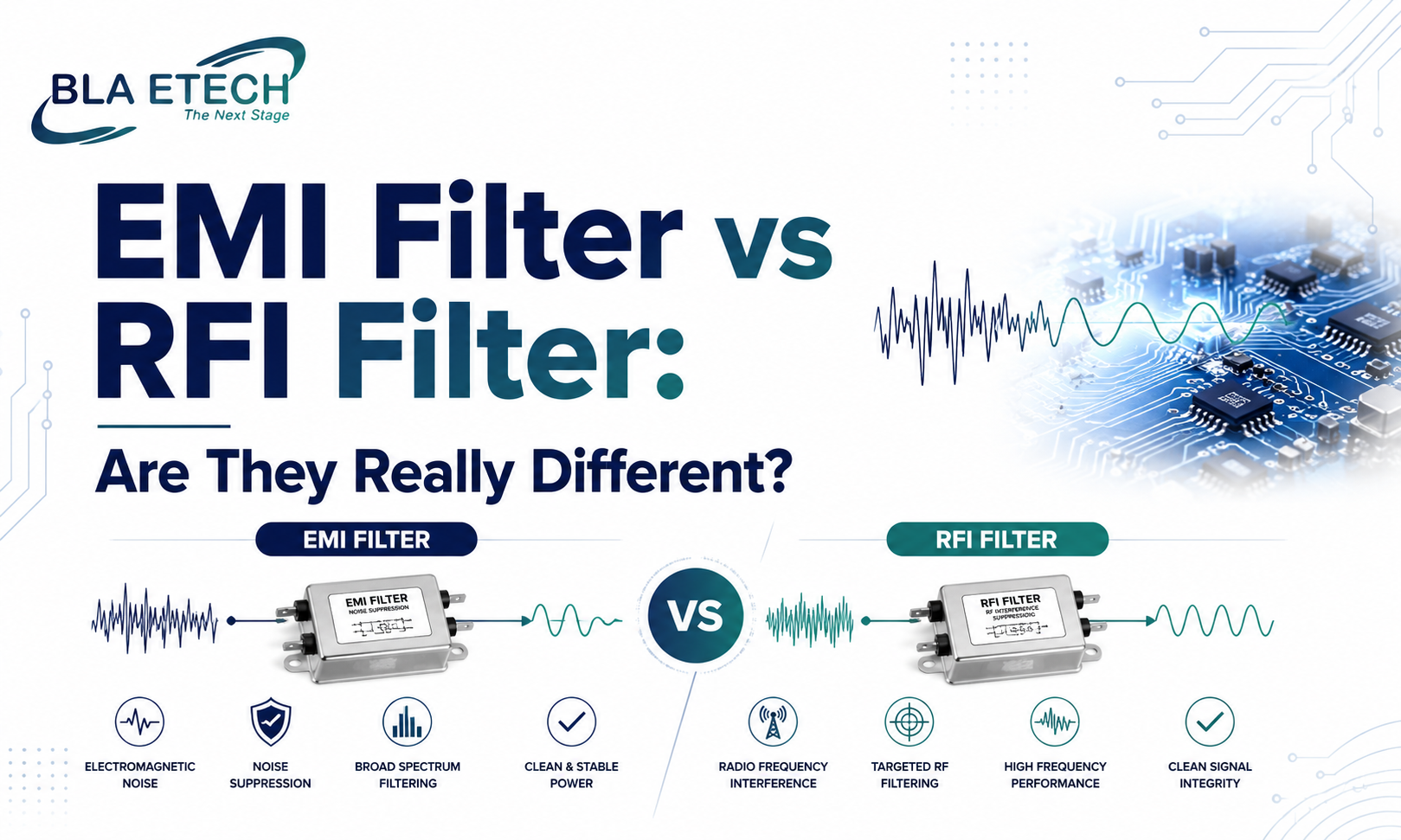
If you've ever spent time searching for power line filters, there's a chance you've noticed something peculiar in the way that some datasheets refer to the part as an "EMI filter," others refer to the same type of device as an "RFI filter," and many use both of these terms within the same paragraph as if they're interchangeable. For engineers trying to pass a conformity test or a procurement manager looking to specify the correct piece for the construction project, this inconsistency isn't only confusing but could result in the incorrect filter being included in the wrong model. In BLA Etech, this issue is asked frequently, particularly by teams that are working with the DC EMI power line filter for the first time or looking into custom single-phase EMI filters in a new line of products. We'll have to decide whether EMI and RFI filters are two different things or are they just different names to do the same thing? EMI means Electromagnetic Interference. RFI is a shorthand for Radio Frequency Interference. RFI is technically part of EMI and is not an independent classification. All RFI is EMI, but not all EMI is RFI. Electromagnetic disturbance covers a larger frequency spectrum, which includes the low-frequency sound that comes generated by switching power supply motor drives and the digital clock's harmonics. Radio frequency interference specifically refers to the high-frequency part of the spectrum. It is the area where interference begins with radio communication wireless signals, as well as the RF-sensitive equipment. If someone is asking if one of the EMI power line filters or one of the RFI filters can be described as "different products," the real answer is that they're designed to deal with the same noise profile. In the informal language of industry, these terms are misused because the majority of commercial filters are made to manage both noise ranges simultaneously. However, from a design point of view, it is important to know the distinction and how you judge the actual performance of filters in your particular application. The moment this becomes an argument over semantics and begins impacting real decision-making in engineering. If your product is only required to pass the conducted emissions test at lower frequencies (say that it's for FCC Part 15 Class A/B or CISPR 32 conductivity limitations), an optimized filter specifically to provide RFI suppression in higher frequencies may cause unresolved low-frequency RFI, and it will not pass the test, knowing the reason. Conversely, if you're designing equipment near sensitive RF receivers, aircraft systems, or medical devices, insufficient attenuation in the RFI range can cause interference that a low-frequency-focused EMI filter simply wasn't built to catch. This is one of the mistakes frequently made where a company purchases the basic "EMI filter" off a catalog and assumes that it will cover their entire scope of compliance, only to be confused during the pre-compliance tests. Most often, the solution isn't an entirely different category of filter; it's knowing exactly what frequency is the source of problems and comparing the attenuation curve of the filter to the frequency area. A properly designed EMI power line filter isn't simply an element you can drop into the circuit. It's an entire system made of the following elements in conjunction: Common-mode chokes - Suppress any noise that is equally distributed in both neutral and line in relation to ground. This is typically the main issue encountered in a switching-mode power supply. Differential-mode inductors address the noise that flows between neutral and line in opposing directions, usually due to ripple current. X-capacitors - Placed across the line as well as neutral, to help shunt the noise of differential mode. Y-capacitors - Placed between neutral and line to reduce common-mode noise. They are sized so that they stay within the leakage current limit. The equilibrium between these components is what determines whether a filter will perform better when operating at low EMI frequencies or extend into the RFI spectrum. That's exactly the reason filtering products that are sold off the shelf don't always work with specific equipment, which is why Custom single phase EMI filters are to begin with the attenuation curve must be matched to the exact noise signature of the device being protected. A majority of discussions on filtering use AC line filtering. But a DC EMI power line filter must solve another issue. There's no obvious zero-crossing option for you to consider, but shifting noise in DC-DC converters is typically broad, and a lot of harmonics, as well as grounding strategies used in DC systems (especially for battery-powered aerospace or automotive applications), are different in design from one model to the next. Some things to know in case you're planning to use a DC EMI power line filter: The current rating and the polarity of the filter are much more important in AC design. The components must be able to withstand continuous DC currents without overloading the core. This is a distinct failure mechanism that AC filters typically face. Noise from common modes is present even in DC equipment, but is usually ignored since engineers believe that common-mode problems are a problem only for AC. Grounding topology affects the effectiveness of filters drastically. Filters that are effective when it is grounded in a chassis can be subpar in a standalone or floating ground design. Instead of beginning by using "EMI filter" or "RFI filter" for your keyword, you should work backwards to your real constraints: Identify your compliance target - Find out the exact norm and frequency you have to meet (conducted emissions, radiated emissions, and/or both). Characterize your noise source - switching frequency, harmonic content, and whether the predominant noise is a differential mode or common-mode. Confirm your power type and current - AC single-phase or three-phase— as well as the current and voltage ratings. Check your grounding and enclosure setup. This can affect the performance of filters in real life more than the majority of datasheets contain. Decide between catalog and custom- When a common component doesn't match up to the profile of your noise, custom single-phase EMI filters or designs that are DC-specific generally cost less than re-engineering a mismatched part later. It is assumed that an "EMI filter" automatically covers RFI interference, without ever making sure to check the attenuation curve. In the absence of DC-specific saturation and grounding concerns when using the AC filtering model. Insufficiently sized Y-capacitors in order to meet the leakage current target, which reduces the effectiveness of common-mode suppression. The filter is placed further away from the sources, or the interference-prone cable entry point can reduce the effectiveness of the filter in real life, regardless of its specifications. Not taking pre-compliance tests and identifying irregularities only in formal accreditation. EMI and RFI don't have to be rivals; they are overlapping elements of the same spectrum, with RFI falling under the wider EMI umbrella. It's not about "which term is correct"; it's about whether the filter you pick actually covers the frequency range that you want to target and the noise pattern your device creates. It could be a conventional EMI power line filter or a DC EMI power line filter that is used in a battery- or converter-based solution, such as custom single-phase EMI filters designed around a particular noise profile. The best decision is about matching the filters to the real situation, not to the description in the datasheet. If you're dealing with an issue with your filtering that hasn't been solved with the help of off-the-shelf components, BLA Etech works together with engineering teams to develop filters that are based on actual noisy data instead of general beliefs. The most efficient method to get through compliance testing is to talk with someone who's dealt with the exact same issue prior to you, and that's exactly the type of support that BLA Etech brings to any filter concept.The Short Answer: One Term Is Broader Than the Other
Why This Distinction Actually Matters for Your Design
What Actually Goes Into an Effective EMI Power Line Filter
DC Systems Bring Their Own Complications
A Practical Framework for Choosing the Right Filter
Common Mistakes Engineers Make With EMI and RFI Filtering
Bringing It All Together


